What does it mean to document a life before it disappears? This is the quiet question at the heart of Life After Siham, a feature documentary screened at this year's ALFILM selection, in which French-Egyptian filmmaker Namir Abdel Messeeh turns the camera on his own family. On its surface, the film is a portrait of his parents' marriage, migration, and quiet life in France — but the film's deeper conviction is that every life contains a story worth telling, and that the act of telling — of insisting — can itself become a form of salvage.
The film places the story of his parents' marriage at its centrepiece from the very beginning. To do this, the director uses footage from the Egyptian cinematic masterpieces The Dawn of a New Day (1964) and The Return of the Prodigal Son (1976) by Youssef Chahine, drawing parallels between the characters in these love story films and his parents, Siham and Waguih. His father Waguih is an Egyptian man who moved to France as a young man in search of better opportunities. His mother Siham, a woman with a distinguished career and cultural standing in Cairo, sacrifices her job, her past, and a previous romantic attachment to be with him.
The film playfully montages sequences from the Chahine films to create a collage-styled narration of his parents' decisions, love, and life story.
Siham takes the central role in the parents' story. She is the one who made the great sacrifice; she is the one who chose Waguih and their path together in France, and Waguih seems eternally aware and grateful for this.
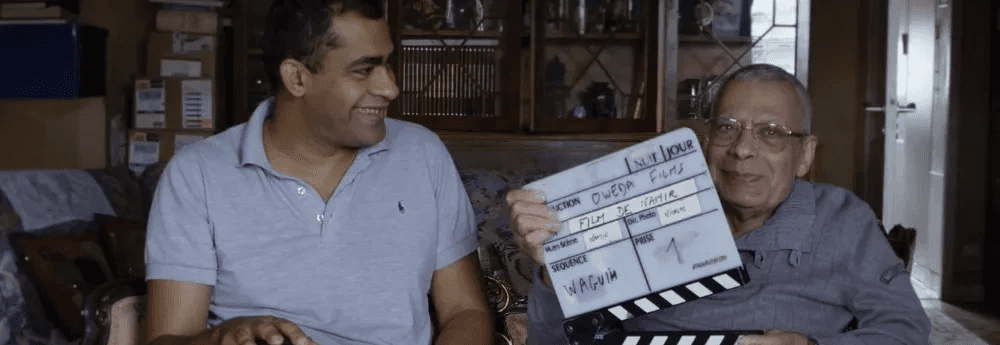
Alongside being an intimate personal portrait of the family, the film comes across as Namir's own quest to explore fragments of his identity tied to his parents' past in Egypt. He continuously films during their trip to Egypt with his mother, spending time with his grandmother and aunts, playfully casting them as actresses in his supposed film. Unlike his parents, who have long accepted the presence of a rolling camera in their lives, the grandmother and aunts find it odd — and Namir plays with this tension.
The film also inhabits the pain and sacrifice the family underwent through migration. This is highlighted in Namir's conversations with his father; despite Namir's insistence, the father has remained more or less silent about his long-lost past in Egypt. This silence and its attendant ambiguity is something true and omnipresent in the lives of many within the migrant experience — the lost past, the people and places left behind, creating a sense of heaviness and grief that Waguih embodies.
Returning to Siham, Abdel Messeeh portrays a nuanced and multifaceted character who took on a dominant role in their household. Her back-and-forths with Namir — as he films and she attempts to find common ground with her son in order to understand this filmmaking thing he is so passionate about — paint her as the true main character. The family unit feels centred around Siham; she is its core.
By shifting temporalities and incorporating both filmic references and footage shot across different eras, the film creates a feeling of nostalgia and prompts us to think about practices such as remembering, reminiscing, and the retelling of stories. Waguih makes the seemingly simple and irrelevant feel worthy of narration.
Waguih seems unable to process the reality of Siham's death until the very end; it is as if he had never once entertained the possibility of a world without her. Namir uses his mother's death to press further and search deeper with his introverted father — and it is only in her absence that his father begins to reconstruct and recall the past, to revisit and relive it. He continually reiterates that Siham has never truly left him.
The film provoked a deep emotional response in me. It made me think of my own lost past, my broken and distant ties to my parents and family, and how desperately I need to inquire and learn more about their stories — to cherish the simply ordinary story of my own parents, which may seem like another ordinary life but is most certainly worth recalling, cherishing, and narrating.
Abdel Messeeh reminded me of the necessity to cherish and reflect on our stories — how each life and each path is beautiful in its own special way, and how the seemingly ordinary often holds so much more than our immediate comprehension allows us to grasp.