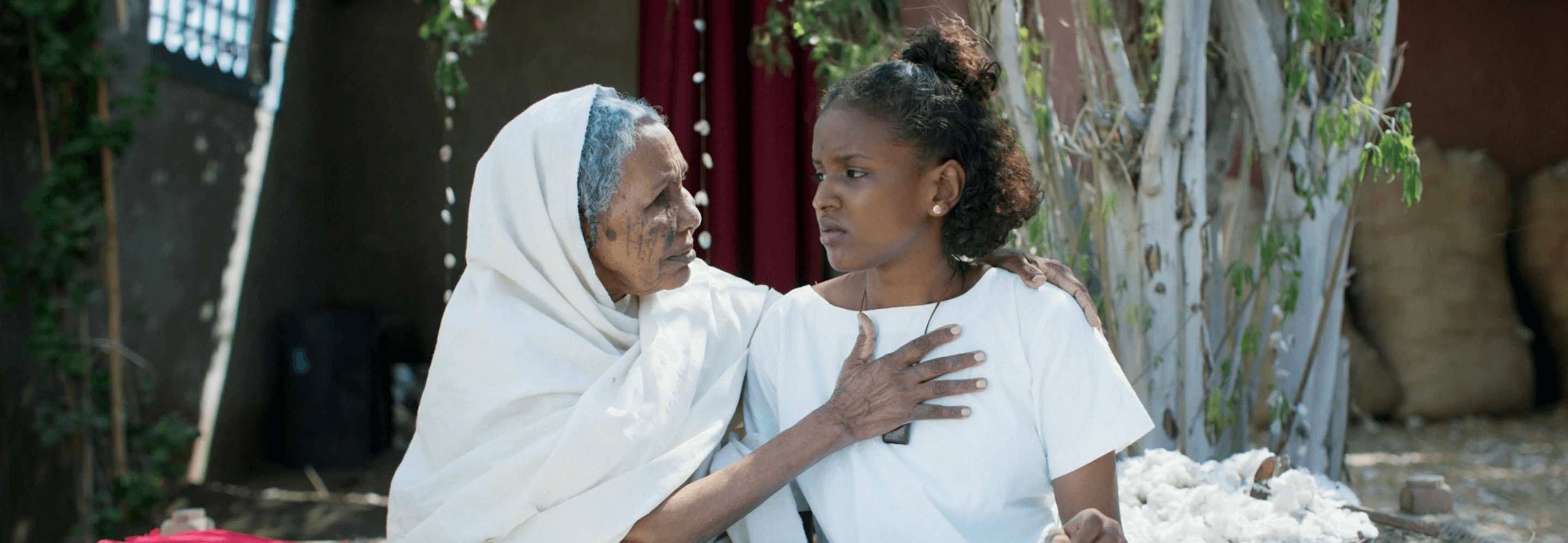
Fifteen-year-old Nafisa (Mihad Murtada) lives with her parents and grandmother Al-Sit (Rabha Mohamed Mahmoud) in a Sudanese village. She spends her summer working the cotton fields with friends, and there she begins to fall for a local farmer boy.
Meanwhile Nafisa’s parents intend to marry her to a wealthy Sudanese businessman from abroad. He arrives not only for a bride, but with plans to transform the village’s livelihood: he seeks to take over the cotton fields and introduce genetically modified, non-reusable seeds, a move that would bind the farmers to corporate dependency.
Standing between this calculated takeover and Nafisa’s future is Al-Sit, known throughout the village as the “Cotton Queen,” a title she upholds with a story she has told for decades: that she was the one who chased the British out and won the village’s independence. This myth has made her the community’s matriarch. Now, facing a new kind of colonization, she must live up to her own legend to protect her granddaughter’s future and the land’s sovereignty.
Mirghani’s drama works on two levels: as an intimate family portrait and as a subtle allegory for Sudan’s historical tensions. If one reads the film as a kind of living timeline, each figure comes to symbolize a distinct phase:
Nafisa’s grandmother, Al-Sit, embodies the mythologized past; not as a fixed record, but as a story that has been lived and retold. Her narrative of driving out the British may be more myth than fact, but it’s a myth born of coping with trauma of survival, one that has given her – and her community – a sense of dignity and autonomy.
Her parents belong to the generation tasked with navigating daily survival, sometimes at the cost of the ideals their elders fought for. They are pragmatists, embodying the compromises of the present, without regarding the potential long-term consequences for the future generations.
Nafisa herself is a teenager of remarkable clarity and will. Unlike many her age, she isn’t swayed by social media, peers, or even the expectations of her family. Her strength feels inherited, almost intuitive; she senses what is truly best for herself and for her village, even when those around her cannot see it. In her, the film plants the seed of a different future: one rooted in self-knowledge rather than outside influence.
The businessman personifies an all-time threat: colonialism in new clothing. Though Sudanese by origin, his exile has turned into entitlement. He returns not to reconnect, but to extract: land, resources, even a bride. His attitude repeats the old pattern of external authority claiming superiority and the right to take without consent.
Suzannah Mirghani’s “Cotton Queen,” is an expansion of her prize-winning short “Al-Sit” (2020). Shot in and around Khartoum and the village of Aezzazh, it’s a finely observed allegory of post-colonial inheritance. Mirghani, who in her other life serves as deputy director of publications at Georgetown’s Center for International and Regional Studies, in Qatar, brings an academic’s eye to the tensions between global capital and local autonomy – yet she never lets the thesis overwhelm the human texture.
What emerges is that rare thing: a work of political consciousness, a complex matter wrapped in a story that feels tender, lucid, and disarming in its simplicity.